Wednesday, 21 June 2023

The Divine DIVA

The big summer exhibition at the Victoria and Albert Museum covers a lot of bases but fails to delve below the surface glitz. Cathy Lomax basks in the glow of the glamour
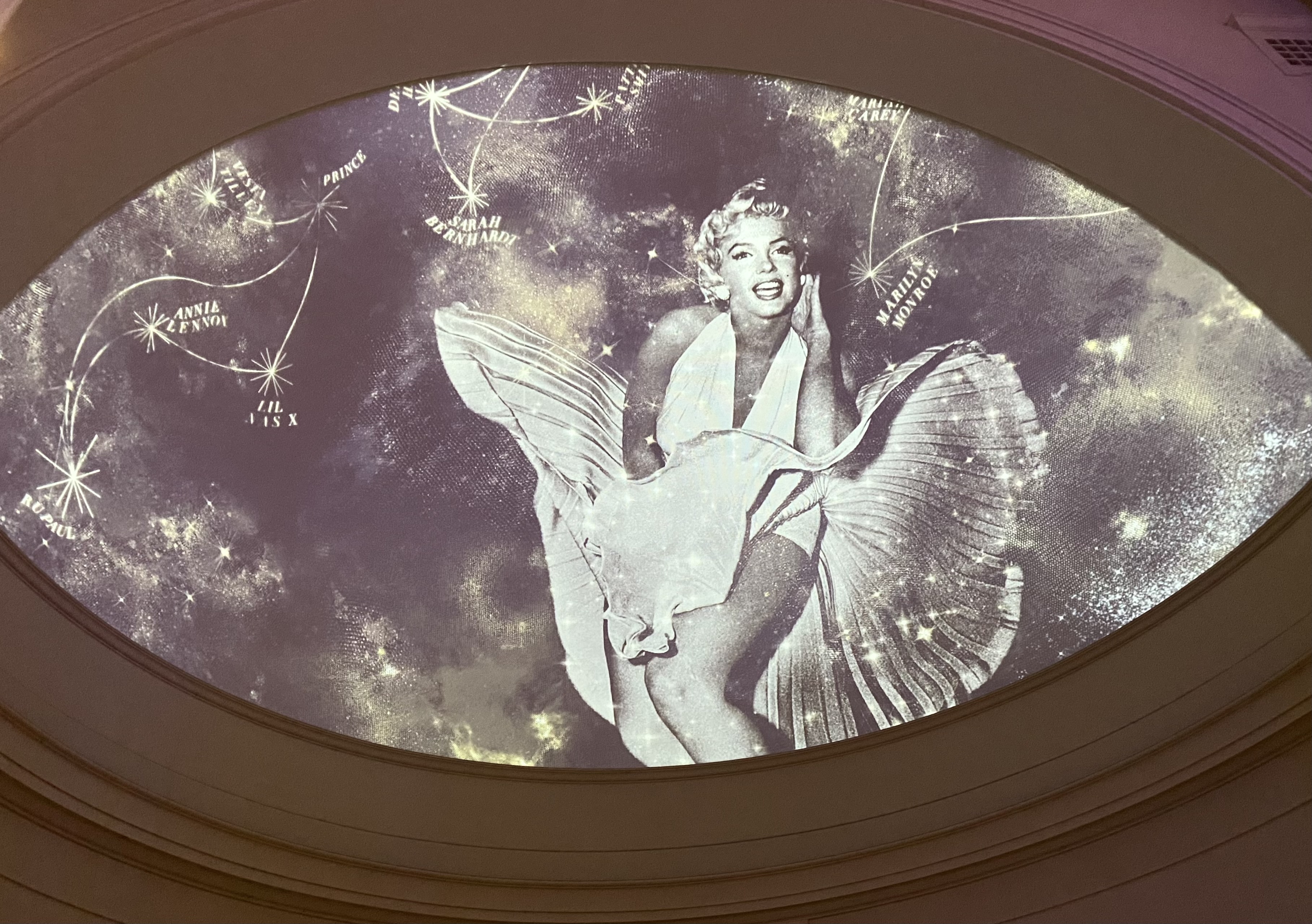
 

Marilyn Monroe projected on the ceiling of the Victoria and Albert Museum above the DIVA exhibition


DIVA begins (naturally) with ‘Act One’ in which the scene is set by two white marble portrait busts of Juno and nineteenth century opera star Adelina Patti. This poetic start neatly leads us to French writer and critic Théophile Gautier who first described the female opera singer as a diva (the Latin word for goddess) as he considered her talent to have been divinely bestowed. Although today's diva still has the heavenly looks the term has expanded and now denotes a flamboyant performer who is also what we might call a prima donna.


Hollywood costumes as worn by Judy Garland, Bette Davis and Joan Crawford


I think I first became aware of the term when the film Diva (1981) was released and as I understood it, it described a highly strung, temperamental opera singer. In the DIVA exhibition opera swiftly gives way to theatre with Sarah Bernhardt and Ellen Terry effectively trailing my favourite section – Hollywood stars. There is some pure gold here with representation from the early days of cinema through to Elizabeth Taylor’s turn in Cleopatra in the 1960s. The film costumes on display are quite spectacular in terms of their importance to film history with this classical Hollywood fan practically swooning at Joan Crawford's Mildred Pierce dress, Bette Davis' satiny All About Eve ensemble and Marilyn Monroe's little black Some Like it Hot dress (other costumes on display include those worn by Clara Bow, Josephine Baker, Theda Bara, Mary Pickford, Carole Lombard, Judy Garland, Vivien Leigh and Mae West). Many of the costumes are brought to life by photographs and well selected film clips. Elizabeth Taylor’s Cleopatra commanding Richard Burton’s Marc Anthony to kneel before her is perfect high camp! Beyond the visual delights the complicated tussle between the exploitation and agency of stars (and women in Hollywood more generally) is suggested in accompanying texts but this is never quite explored thoroughly or argued convincingly. 


Cleopatra (1962)


A note here about the audio guide which rather than the usual dull and user-unfriendly offering was cleverly broadcast from a set of headphones that sit above the ears and respond automatically to exhibits providing musical and film sound accompaniment rather than wordy (often tedious) explanations. This soundtrack propelled me through the exhibition and helped to smooth over some of the more clunkily and tenuous inclusions of the chosen cast of mostly female stars. 


Bob Mackie talks Cher


Upstairs in ‘Act Two’ the emphasis is on ‘the diva today’ and it is musical stars (of all genders) that dominate. Alongside Beyonce, Rihanna and Lady Gaga, there is a stunning centrepiece featuring some of Cher’s figure-hugging bespangled outfits designed by Bob Mackie. It was only after circling the exhibit that I realised that the dapper elderly gentleman being interviewed was Mr Mackie himself! 


The austere Edith Piaff exhibit


I am not any clearer about what exactly it is that the exhibition defines as a diva – profiles of performers as disparate as Nina Simone, Siouxsie Sioux, Edith Piaff, Elton John, Sade, Ella Fitzgerald, Janelle Monáe, Prince, Kate Bush and PJ Harvey are closely clustered together. Is a diva a show off? Or maybe a successful entertainer who likes dressing up? The press release describes the ‘Act Two’ divas as reclaiming the title and using it as ‘an expression of their art, voice, and sense of self’. But surely Billie Holliday and Ella Fitzgerald made a living singing and their emphasis was on music rather than image. I suspect the pull will be the contemporary ‘divas’ with their Met Gala outfits who in effect operate as successful business people rather than artists per se. Rihanna, we are told, is the wealthiest female musician in the world with her $1.7 billion fortune mainly built through her 'suite of companies'. But there are efforts to link these contemporary divas with their Hollywood counterparts. Such as a 2017 sketch of Rihanna’s Fenty Beauty makeup which recalls a caption describing Mary Pickford’s makeup line of the 1930s which is displayed alongside her makeup case in Act One. And of course Elizabeth Taylor demanded and received a $1 million dollar fee to play Cleopatra, which made her the highest earning performer in Hollywood history. So maybe little has changed!


Sketches for Rihanna's Fenty Beauty makeup, 2017


Mary Pickford's makeup case, circa 1938


There is a lot to enjoy here but it is only a very brief introduction to the style and careers of the very many talented people represented. Maybe more of a focus on a particular era, or a reduced list of featured artists, would have made for a better exhibition? As it is the diva premise feels a little woolly (film director Lois Weber may have been a female pioneer in early Hollywood but not sure why she is a diva) and this is really a mere introduction to these magnificent performers with extra work from the viewer essential to fill in the details of their dazzling and fascinating careers. 


Cathy Lomax

June 2023


DIVA

Victoria and Albert Museum

London 

24 June 2023 – 24 June 2023


Tuesday, 20 June 2023

The Folly of Follies: The Wedding Cake at Waddesdon

Rosemary Cronin indulges her inner child by climbing into Joana Vasconcelos' giant ceramic wedding cake at Waddesdon Manor 


Do you remember the first artwork that captured your imagination when you were a child? I have a few, but a really vivid memory is seeing Karl Lagerfeld for Dior’s Piano Key cocktail dress in the Victoria & Albert Museum. I think I must have been eight years old, and every half term my mother would take me up to London and we would see things that would just fill my little heart and mind with delight. But that dress really made my imagination take flight… I imagined who might wear it, an elegant beautiful woman at the best party in Paris, drinking champagne and falling in love – I was eight years old remember! Young and naive I didn't realise that the dress has rarely been worn, and probably went straight from catwalk to the vitrine in the museum, or even worse storage.


Imagine then, if you can in this hyper virtual world, being taken as a child today to a 12-meter-tall, ceramic, wedding cake building that you can climb up! One made up of edible colours like pink blancmange, baby blue icing and yellow fondant, with fibre optics that light up at night! And this cake building of wonder is on a fairy-tale-like 1800s manor estate surrounded by forests, fountains and a rather spectacular aviary. Surely you would be captivated and spellbound, and in a feeling akin to a sugar rush – a little delirious ?!


Portuguese artist Joana Vasconcelos has found in Lord Rothschild, in her own words, ‘someone who is as eccentric as me, and someone that can believe has high and wild as me’. Together over the last five years they have created ‘impossible dreams, impossible artworks – we all have them!’ and whilst they flippantly referred to Wedding Cake as a folly of follies, it actually feels like something far more special and magical than most people could dream of. Seeing them talk together was a beautiful moment, a friendship of two souls that have made magic together and have clearly found a solution to any problem that may have arisen in making this spectacular installation.


Waddesdon Manor with its treasure box of artwork, jewels and precious furniture pieces, with Wedding Cake has added : ‘a temple for people to be happy and to have a moment that they will never forget’. If you haven’t been to Waddesdon then I thoroughly recommend a summer sojourn to the estate to see both Wedding Cake and Mia Jackson’s curation of the Rothschild Treasury – a truly wondrous display of more than 300 objects made from rare and precious materials. 


Rothschild and Vasconcelos’ triumphant partnership proves that fairy tales can come true, and are even available to the public to enjoy!


Rosemary Cronin

June 2023


Visit Joana Vasconcelos: Wedding Cake at Waddesdon Manor until 26 October 2023


Waddesdon Manor

Aylesbury

Buckinghamshire HP18 0JH


Friday, 16 June 2023

'A shiny ghost stops me at the edge'

Jennifer Caroline Campbell has a poetic response to Lotus Laurie Kang's artworks in a show at the Chisenhale Gallery. 


Photos Jennifer Caroline Campbell


Lotus Laurie Kang's multidisciplinary practice lets the process lead the way forward. Her work utilises a fine-tuned sensitivity to materials and their liveliness. The work often carries on developing beyond the conventional finishing point, and so, just like us, it is in a state of perpetual becoming. Her current installation at Chisenhale Gallery, In Cascades, is her first institutional solo exhibition in Europe, and I hope it is the first of many. Here is my response to it:


Slow sun bathing through glass panes. 

Writhing shapes in the sand.

My body moves the air, nudging the glossy slithers that hang from a perforated, gleaming grid. 

Thin slices of remembered light, still forming. 

A sunset in a darkroom, repeated. 

I might fall into the seams, like the silver bits. 

Lined up twists of kelp, anchovies and cabbage. 

I keep moving, looping.

A shiny ghost stops me at the edge. 

Two rigid mice, clinging and gone. 

Or a mirrored twin. 

I turn back in like a ball bearing.

My reflection licks just above the floor. 

Edges breaking. 

Small hard spheres hug through a slippery surface, gripping and ready to let go of the curling film. 


Jennifer Caroline Campbell

June 2023


Lotus Laurie Kang, In Cascades 

Chisenhale Gallery, London E3 

2 June – 30 July 2023


Friday, 2 June 2023

It Started with a Kiss

Jennifer Caroline Campbell discovers a hidden LBGTQ+ history embedded in carnival ephemera at Auto Italia in east London.

It all changed with a kiss. That is, according to scattered whispers, local gossip and anecdote. It was 1974 and carnival season in the plurinational South American state of Bolivia. A glamourous Las Chinas Morenas performer named Barbarella approached dictator Hugo Banzer Suárez, and gave him a kiss. The fragments of this story, the context that lead up to it, and its legacy, have been carefully gathered by David Aruquipa Pérez, a Bolivian artist, archivist and activist. He has worked with London based, Quechua-Spanish artist, Aitor González Valencia, to present this vital piece of history in an exhibition titled Barbarella’s Kiss at Auto Italia. The main focus of the exhibition is a collection of 41 photographs, which are laid out in minimal orderly fashion in brightly colored glass-topped vitrines. All from the pre-digital era, these photographs show their stories in their physical features as well as what the lens has captured. One is torn at the edge because it was hurriedly snatched from a photo album before a conservative relative could see it. In another a man’s face has been scratched out. Others are curling and scuffed on their white borders and one appears to have been reproduced as a postcard. 


Looking down into these crystalised moments is like glimpsing snatches of a temporary world, one that is brought into reality by the will of the performers. It reminds me of when I first saw the Casa Susannaphotographs, a collection of snap shots taken by cross dressers who regularly met up (and dressed up) in a particular house, during the 1950s in upstate New York. Although the context is very different, both collections of photographs have a snow-globe quality. To me they are like windows onto a contained realm, where temporary and communal freedom crackles and darts between glances, body language, fashion language and fake eye lashes. 


Both collections work to undo the willful forgetting that has been imposed on the rich history of non-conforming gender diversity, a history that the dominant narrative has only just begun to acknowledge. Both document a particular way of performing for the camera and an embodiment of temporary identities. But the spaces that these activities took place in are very different. The Casa Susanna photographs were, until their rediscovery, private. They were made of and for the guests at the Casa Susanna house and their small community. Rather than a by-product or even an intentional document they were instead a way of constructing a self. When discussing the Casa Susanna collection, professor of philosophy and cross-dresser Miggi Alicia Gilbert said ‘When you can’t be who you want to be, whenever you want to be it, then those images are a reassurance. They’re a recognition that say yes, I can do that, I can be that person as well as the one I happen to be now’. 


The photographs on show in the Barbarella’s Kiss exhibition feel more haphazard. The La China Morenaperformers were not allowed access to photography studios and appear not to have had a safe space to play in, like the Casa Susanna regulars did. Their posing is fierce, provocative, laced with political action and deep routed local beliefs about the plurality of identity. The way the performers hold the space in front of the lens somehow reverses that often exploitative power dynamic, where the person behind the camera has all the agency. Barbaralla and company are not subjected to the camera, they demand its attention.


Many of the snapshots were taken by photographers who would then sell them to the festival goers. In this sense these photographs become mementos of the festivities, and perhaps the novelty, of a carnival day. But there is a certain power contained in these mementos that lives on beyond the day of celebrations. The Barabrella’s Kiss exhibition made me think about how a temporary and elevated arena can provide a vital space for reimagining. In Ursula K Le Guin’s essay A Non-Euclidean View of California as a Cold Place to Be (1983), she refers to Robert C Elliott’s idea of participatory festivals as temporary utopian intervals, that sit outside of daily time. She talks about them summoning the ‘dreamed-of golden age of equality’ into the present lived world. This imaginative transformation, she says, prevents utopian thinking from forming into that ever-promised future, that dangerous rationalist dream that so easily becomes totalitarian. 


In some of the photographs the performers are wearing traditional masks to protect their identity. In the later ones, the backdrops become more rural as the Las Chinas Morenas performers are forced out of the urban festivities, following their persecution after the fallout from that legendary kiss. Another change that happened after the kiss is that women were allowed to perform at the street carnivals, when previously they had been excluded. What is allowed within the confines of a carnival day is different from, yet has a real effect on, what happens outside of it. A line from Le Guin’s essay hangs in my mind: ‘the exiles from paradise in whom the hope of paradise lies’.


Jennifer Caroline Campbell


Barbarellas Kiss is at Auto Italia until the 11 June 2023. 


Monday, 22 May 2023

Listening to Kesha's Gag Order

Rosemary Cronin feels the magic as she listens to a new album by American singer and songwriter Kesha


I’m not sure if anyone else noticed the tiny white feather fall in front of the screen when the DJ pressed play on Kesha’s new album, Gag Order. I was at a listening party hosted by Dazed, and what felt straight off sermon-like unfolded into even more of an unexpectedly spiritual experience. 


The lyric booklets were lined on the benches, like prayer books on pews and we were bathed in red light. Kesha’s former works are not reflective of this reverence; instead she became known for her bubblegummy, brash and bold dance-pop hits like Tik Tok and Blah Blah Blah. But a quick read into her journey through stardom tells us that the ride has been bumpy, fast, furious and full to the brim with massive highs and crashing lows. 


Like many women in the music industry, Kesha has been on a rollercoaster, turned back-to-front and upside down; and like a lot of her female counterparts the chaos has mainly been caused the men that have driven the career. Kesha’s visual creative collaborator for this album, Brian Roettinger, seems to have riffed off that energy but instead is a safe pair of hands to work with, and knowingly, respectfully works with the ethos of the singer’s new work. All the typography for the visual identity around the album echoes the mayhem of what the muse has been through; the typography laid out back-to-front, upside down, mirrored unexpectedly whilst still being recognisable. Perhaps we are used to our female musicians carrying this lived experience?


Everything is stripped back; from Kesha’s lack of makeup in the videos to producer Rick Rubin’s use of Kesha’s own voice notes together with Sunday service organ-esque keys as recorded elements within the finished album. There’s a lot of self-flagellation within the lyrics ‘You don’t wanna be changed like it changed me’ (Eat the Acid) and ‘There’s a fine line between what’s entertainin’ and what’s just exploiting the pain’ (Fine Line) and to real push the sacred envelope ‘it’s time I’m comin’ down off of the cross’ (Fine Line). At the mid-point we are gifted a Ram Dass interlude, with Kesha revealing that after being in treatment for bulimia she was given a copy of Dass’ seminal ‘Be Here Now’ and has carried it with her ever since. 


The album ends with the song Happy that samples a recording of a wizard friend (who doesn’t have a wizard friend nowadays?), saying ‘Sometimes you think you’re doing the magic and sometimes the magic is doing you’. At the launch party Kesha was there in an immaculate white dress with matching white kitten heels. With a radiant glow shining over her, she’s not been reborn, but there is a graceful vengeance in the album that has clearly rebuilt her over years of trauma, and she feels like she is carrying magic. 


Although there is this spiritual side to the work, there are still tracks that are clearly made to end up as remixes on dancefloors. Kesha probably knows that these songs will be diced and spliced, chopped and changed – but this time it feels like she’s more in control than ever. 


Rosemary Cronin


Keisha, Gag Order, is available from all the usual music streaming platforms


Thursday, 16 February 2023

Up Close and Impersonal with Joseph Yaeger

Alex Michon goes ‘eye-sight’ seeing, getting close to some canvases which on close inspection reveal a magical painterly alchemy.


Visiting the Joseph Yaeger exhibition was a timely reminder about how paintings should be seen up close, in reality, and not just experienced in digital reproduction. His show at The Perimeter was a revelation, since being in front of them and seeing the way the paint was applied created a completely different reading from an initial view of the images online.


From those digital glances the paintings appeared to be very photo-realistic, kind of old school ‘proper painting’ which I found a bit meh! But when standing in front of them I discovered a curious incongruous messiness, a blurry ricky-tickiness which my painter friend explained was known in the vernacular as ‘painterly’. They were nothing short of magical. Some strange sloppy alchemy was at play, so that if you stood further away they seemed to hyper-realistic and intricately painted, while in close-up they revealed themselves to have a strange sort of splodgy unfinishedness which nevertheless made up a composite whole. What read as a shadow on a face when viewed a few meters away, up close was nothing short of a thin daub! They reminded me of standing up close to some of Goya’s paintings where a hand would appear as a kind of sketchy afterthought but when viewed from a distance was a perfectly acceptable rendition of a hand.


Yaeger is obviously a highly accomplished painter, but the paintings show that he treats accomplishment with the disdain it deserves. His paintings achieve their power by what seems like any means necessary. It reminded me of a Joan Didion quote where when describing her writing style, she said ‘Grammar is a piano I play by ear’. Yaeger appears to paint by instinct, with ‘appears’ being the operative word as there is obviously a sure tried and tested technique here. 


Now this is not some kind of luddite call to arms for technical perfection and I cannot remember any other exhibition which has left me waxing so lyrical about the artist’s painterly methods (save perhaps for the aforementioned Goya) but here the magical mash up between subject matter and application gelled into a kind of road to Damascus moment of the joy of looking.


The title of the exhibition Time Weft hinted at some kind of temporal intention, yet the paintings’ narratives seemed disjointed, snatched glimpses from moments which had some kind of untold relevance.  The artist states that ‘The imagery I use is a protracted search to better understand myself; playing or putting on roles that might clarify an interior that is sort of naturally hidden, even from myself.‘ There is certainly an element of filmic masquerading going on in the painting of a woman shielding her eyes, a man peering through oversized glasses, a hand holding out a pill.


Didion, whose works I had been discussing with my friend on our way to the show, cast a ghostly shadow over my reading of the images. There was an undefinable just out of reach Americana quality to the paintings (Yaeger is American) and like Didion’s prose they seemed coolly detached whilst at the same time emotionally resonant.


Yaeger, I found on further research, is being touted as a new art star in the art firmament. No matter, the paintings are a joy to behold, stories which need to be seen viscerally from the distance of a few inches back and then studied again to appreciate their subtle sleight of hand enchantments. 


Alex Michon


Joseph Yeager: Time Weft

The Perimeter

London

Until 18 February 2023

Wednesday, 25 January 2023

The Less than Familiar Cezanne

Cathy Lomax takes another look at Cezanne's paintings


I find it hard to look at Cezanne landscapes and still lives. All those apples, oranges, green fields, and blue skies merge into what has become a horrible cliché. I have seen them so often my eyes are bored. I know this is sacrilege and that Cezanne is a genius, but over-exposure can be a terrible thing. So it was with little excitement that I went to see the latest iteration of the Cezanne blockbuster at Tate Modern, and I was only there because as a Tate member it was free.


Madame Cezanne in a Red Armchair, c.1877, oi on canvas


What I discovered is that I love his portraits. The hints of smudgy red, the pleasingly undetailed grumpy faces of his models shadowed in blues and greens. Madame Cezanne in a Red Armchair, 1877 is a stunning painting. The complete lack of consideration for the humanity of Mme Cezanne who is merely part of the composition is fascinating – the blue bow, the greens in her striped skirt, the enveloping red of the armchair, the checkerboard shadows on her face, the gold green of the wall – all are perfectly balanced. I have seen Madame Cezanne before, notably at a show of Cezanne portraits at the National Portrait Gallery in 2018, but some of the other works with figures are new to me. For instance The Murder (which comes with a trigger warning) which shows two men violently attacking the prone body of a women, the limbs of one of the murderers are brightly illuminated against a subfusc deep blue/green sky. It’s dark and nasty, more Manet than Cezanne. 


The Murder, 1870, oil on canvas


The portrait of Black Academie Suisse model Scipio (which was owned by Monet) is, unlike Mme Cezanne, bathed in humanity. The caption describes how Cezanne would have been familiar with debates around enslavement, and it’s easy to read the seeming exhausted Scipio, his long lean back turned out as he rests his weary head against his arm, as a political comment. At a quick glance it would be easy to mistake this painting for one of Lynette Yiadom Boakye’s enigmatic portraits of fictitious Black subjects. 


Scipio, 1867


Alongside this masterful spare portrait are some fussy small works depicting boxy female nudes. The most interesting of these The Eternal Feminine, 1877, has a loosely painted women, with red blobs for eyes, lying naked on a bed, surrounded by men – there could be photographers amongst the crowd, but a bit of research reveals them as writers, lawyers, and a painter. 


The Eternal Feminine, c.1877, oil on canvas


My favourite works are two versions of Portrait of the Artist’s Son. The first from 1880 shows the boy against a background of Cezanne’s characteristic undulating blue scrubbed with swatches of green. This colour is reflected in the shadows on the face. The rather lumpish shape of the figure is balanced by the flattened curved top of an armchair which is rendered in shades of aubergine. 


Portrait of the Artist's Son, 1880, oil on canvas


The second Portrait of the Artist’s Son, 1881-2, is unfinished. The boy’s head is tilted towards the left, his eyelids lowered. The dark blue/grey background is scratchy, and the whitish primer shows through. Either side of the head are untidy patches of aubergine/brown which recede to allow the face to stand out. The patchwork of colours that make the face are comprised (in common with other Cezanne works) of short diagonal brush strokes. The portrait is tender and moving. 


Portrait of the Artist's Son, 1881-2, oil on canvas


All the works I have described are hung on a brownish/purple wall – a colour snatched from Cezanne’s use of a similar aubergine-like tone in the paintings of his son. And it works beautifully.


I guess the moral is to look rather than assume you know an artist’s work! 


Cathy Lomax

January 2023


Cezanne

Tate Modern, London

until 12 March 2023